Industrias Cruz CentroOffice furniture and storage
From WordPress to Next.js with Odoo integrated, without losing what search had earned
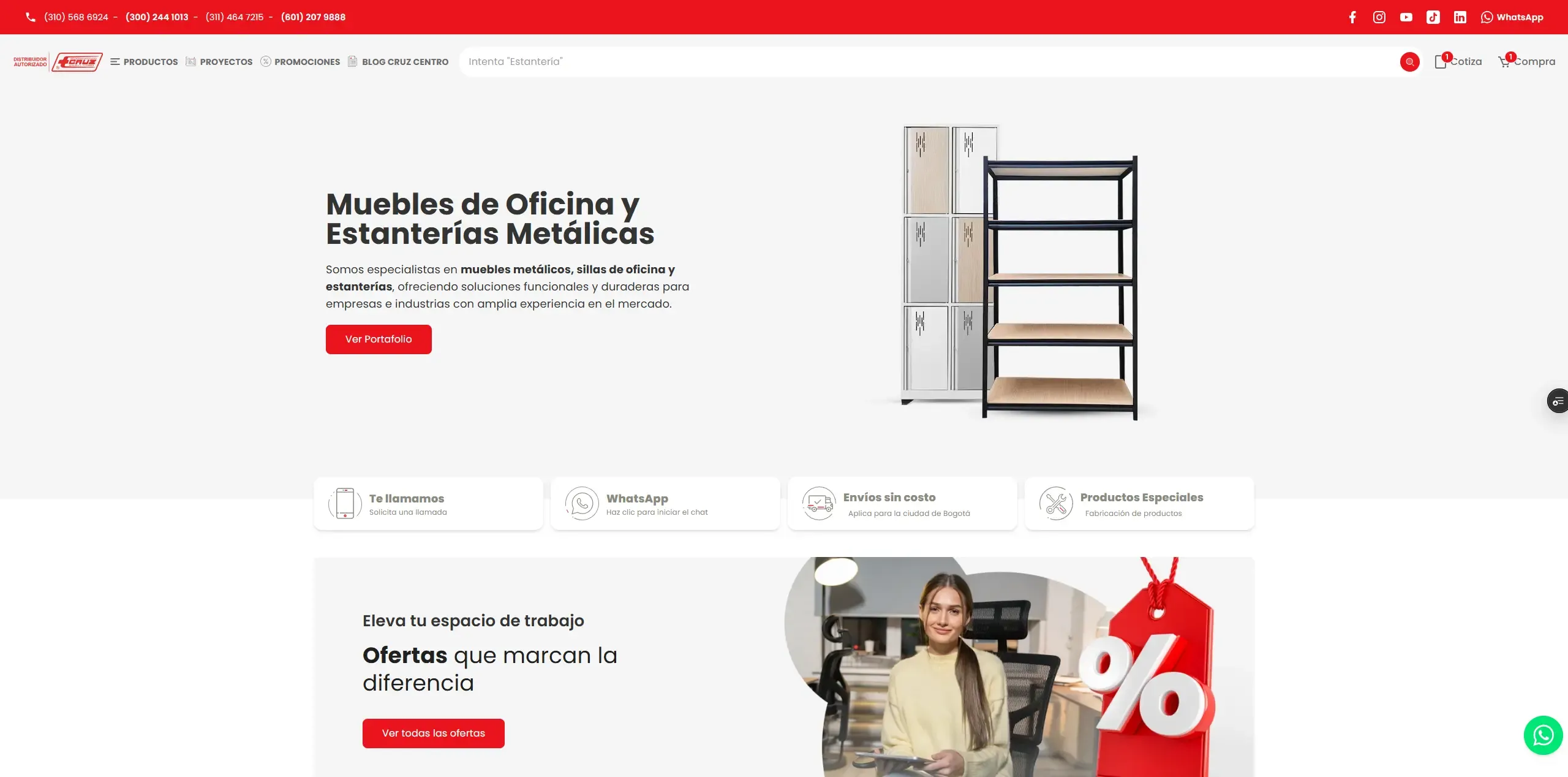
We started around 2017 with their WordPress and have worked together ever since. In 2025 the main site moved to Next.js with Strapi and Meilisearch; we also implemented Odoo and run their infrastructure.
Results
- One relationship, two architectures
- 2017 — today
- We started with their WordPress around 2017. When the business asked for more, the main site moved to a new platform and the relationship carried on as before.
- ERP implemented and evolving
- Odoo
- We implemented Odoo for the company, we maintain it and we keep extending it with new features, alongside other custom integrations and automations.
- Two businesses, one catalogue
- B2C + B2B
- Consumer sales and corporate operations, with online quotes and credit applications, on the same product base.
- A migration that looked after search
- Ranking kept
- Planned to keep the organic traffic the WordPress had earned over the years. The site still ranks well today.
A long relationship, across two architectures
Industrias Cruz Centro is an authorised distributor for Industrias Cruz (office furniture, school furniture and metal shelving), and results have made it the largest in the network on digital channels. They are our longest-standing client: we started around 2017 and have worked together ever since. We have built more sites and landing pages for them than we can count; this case is about the main one, which has lived through two architectures.
The first was a WordPress. And it worked: we took it to a level of customisation with little left of a template, and to search positions that helped the business grow for years. It isn’t the part usually told in a migration story, but it is the part that gives the rest its meaning: when the time came to change, that was what had to be looked after.
When does a WordPress run out of room?
There came a point where the limit stopped being technical and became commercial: the catalogue kept growing, operations kept getting more complex, and the system couldn’t follow. It wasn’t breaking; it simply no longer covered what the company wanted to do next.
When you built the system yourself, the comfortable thing is to keep patching. We preferred to raise the change in good time, and in 2025 the new site went live.
The new architecture
We built a Strapi backend, with Meilisearch as the search engine across an extensive catalogue, in Docker containers on infrastructure we manage ourselves. On top, a Next.js frontend.
The catalogue is managed from Strapi and grows at the pace of the business: publishing a product takes minutes, not development work. And the advanced search keeps that catalogue, however large, navigable both for someone searching “cafeteria chair” and for someone searching a specific reference they already know.
The migration was planned around one condition: not losing what the WordPress had earned in search. URLs, categories and product pages were designed to keep that traffic, and the site still ranks well today.
B2C and B2B on the same site
The catalogue serves two businesses with different expectations. A private buyer wants to find a chair and buy it. A company furnishing an entire office wants exact references, volume and terms: that is why the site lets them request a quote online and submit a corporate credit application without leaving it.
Supporting both journeys without building two sites requires search, categories and product pages to work equally well for each. That is why search is a central piece of the project rather than an accessory.
Odoo and what sits behind the website
With Industrias Cruz Centro the work outgrew the website long ago. We implemented Odoo as the company’s ERP, we maintain it and we keep extending it with new features, alongside other custom integrations and automations that take care of internal tasks. We also manage the server where several of their services live, and we build pages and landing pages for their campaigns.
They usually bring the design; we bring the infrastructure, the technology and the judgement on what is worth building at each point. It is the way of working that best describes us: more than a website, the client has someone who knows their operation and stays alongside it.
What comes next
It’s a live relationship: features keep being added, the buying experience keeps being refined, and the site keeps being measured. Whatever the business launches next will be built on this same base.
We have been with them longer than the technology we started with. That they are the ones who recommend us to other clients is, of all the results in this case, the one we value most.